Our Systems on Chip Designs
Benefits of Buying our Systems on Chip IP Designs :
50 Key Improvements for high tech companies
-
Energy consumption of AI inference: - 60% to - 80% vs typical edge AI designs.
-
Latency reduction for closed-loop control: - 40% to - 70%.
-
Thermal drift correction overhead: - 50%.
-
Runtime fault recovery downtime: - 90% (vs manual resets).
-
Layout turn-around time (EDA pipeline): - 30% faster.
-
Time-to-market for new domain chip: - 25% reduction.
-
Power gating overhead: - 35%.
-
Yield loss due to thermal/voltage variation: - 45%.
-
Hardware security breach risk (side-channel): - 70% reduction.
-
Cryogenic interface overhead for quantum systems: - 50%.
-
Device count for equivalent performance: - 40%.
-
Cost per inference (edge): - 55%.
-
Infrastructure cooling cost (cryogenic): - 30%.
-
Chip area for embedded control logic: - 20%.
-
Verification iterations (HW/SW) for control loops: - 35%.
-
AI-driven layout optimisation time: - 45%.
-
Self-optimisation failures during mission: - 80% fewer.
-
Data-centre AI energy per task: - 50% (with on-chip control).
-
Supply-chain latency impact (energy grid control): - 30%.
-
Radiation-induced failure for aerospace: - 65% reduction.
-
Interconnect losses (cryogenic domain): - 40%.
-
Neural model adaptation time (hardware): - 60% shorter.
-
Software-hardware rework cycles: - 50% lower.
-
Operational cost of remote systems (satellite): - 35%.
-
Logical control node count needed: - 45%.
-
Memory bandwidth overhead: - 30%.
-
Firmware update risk windows: - 55% shorter.
-
Energy per bit transferred (quantum link): - 45%.
-
Autonomous decision-making latency: - 70% faster.
-
AI model retraining frequency: - 30% fewer.
-
Self-test downtime intervals: - 80% fewer.
-
Silicon mask iteration cycles: - 25% fewer.
-
Development cost per chip iteration: - 20%.
-
Edge-AI inference cost for grid control: - 60%.
-
Satellite power management cost: - 40%.
-
Cryogenic electronics package cost: - 30%.
-
Device count per mission chip: - 35%.
-
Security layer hardware overhead: - 20%.
-
Thermal management subsystem cost: - 45%.
-
AI-accelerator reliance on external controller: - 70%.
-
Model-mismatch errors in AI/physical domain: - 55% fewer.
-
Cold-start time in quantum system: - 30% less.
-
Chip risk failure rate in space deployment: - 60%.
-
Verification engineer hours for SoC: - 40%.
-
Layout-route congestion in mixed AI/control chips: - 35%.
-
End-of-life rework cost: - 50%.
-
Scalability cost for multi-domain SoCs: - 30%.
-
Energy footprint per inference (quantum-classical interface): - 50%.
-
Time to integrate new domain (energy, mobility, space): - 25%.
-
ROI acceleration in first year of chip deployment: + 30% to + 50%.
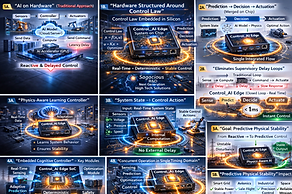

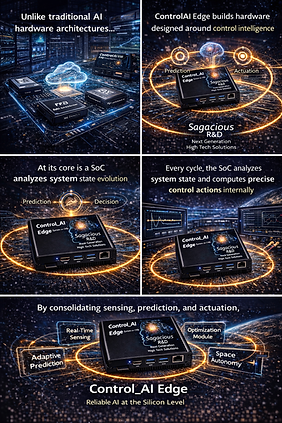


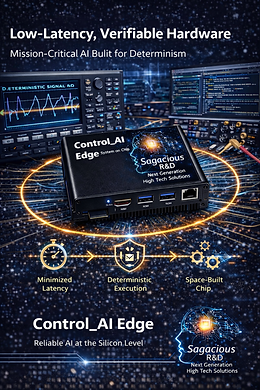


1. HADRO-SoC — Hybrid Adaptive Deep Reinforcement Optimization System-on-Chip
A neuromorphic SoC integrating deep reinforcement learning cores with adaptive control logic. The architecture autonomously optimizes power, thermal, and computational balance in real time across heterogeneous domains, providing aerospace-grade reliability and sub-millisecond convergence beyond conventional GPU-based compute fabrics.
2.PINN-MPC SoC — Physics-Informed Neural Network with Embedded Model Predictive Control
This processor fuses data-driven neural layers with model-predictive feedback controllers in silicon. It continuously linearizes nonlinear dynamics for precision control, achieving self-stabilizing voltage, current, and frequency regulation for intelligent power grids and energy-autonomous robotic or vehicular systems.
.jpg)
Heading 6
.jpg)
03
UCM-Transformer SoC — Unified Cross-Domain Multimodal Transformer Architecture
A unified transformer engine enabling concurrent computation of multimodal data streams—vision, telemetry, and energy vectors—within one reconfigurable silicon domain. The SoC supports tensor-level attention pipelines, integrated signal fusion, and adaptive bandwidth allocation for smart-grid and aerospace mission autonomy
04
NeuroBlockGrid SoC — Neuromorphic Grid Intelligence Processor
Implements hierarchical spiking neural cores optimized for distributed grid intelligence. It executes real-time reconfiguration, fault localization, and predictive recovery through event-driven computation, delivering deterministic stability and zero-downtime resilience across multi-node electrical infrastructures.
.jpg)
5. HADRO-Net SoC — Deep Reinforcement Energy Optimization Engine
A hardware-embedded optimization network using actor-critic reinforcement algorithms for multi-sector load orchestration. HADRO-Net minimizes latency, power spikes, and operational cost through on-die policy adaptation, achieving dynamic resource allocation unmatched by legacy energy-control architectures.
✈️ 6. AeroCast-A3C SoC — Asynchronous Advantage Actor-Critic Processor for Aeronautics
An ultra-low-latency SoC implementing asynchronous actor-critic agents directly in silicon for flight systems. It performs autonomous navigation, fault-tolerant control, and trajectory optimization under stochastic environmental variations, maintaining mission integrity at sub-watt power envelopes.
⚙️ 7. GRNN-SoC — Grid Reconfiguration Neural Network Accelerator
Integrates graph neural network (GNN) accelerators with high-bandwidth memory controllers for instantaneous grid topology computation. GRNN-SoC executes millions of node updates per second, enabling predictive switching, adaptive routing, and real-time stability assurance across smart utility networks.
🛰️ 8. LEO-Optimization SoC — Low-Earth-Orbit AI Optimization Processor
Radiation-hardened SoC for autonomous satellite subsystems. Incorporates fault-tolerant AI inference, adaptive orbit-control kernels, and deep-space communication compression engines, providing self-healing functionality and real-time energy optimization within extreme orbital thermal and radiation constraints.
🔋 9. NeuroCore-MPC SoC — Intelligent Power and Control Core
A hybrid AI-physics computation core executing predictive optimization loops at hardware speed. It synchronizes sensing, estimation, and control to sub-microsecond precision, enabling robotics and industrial automation systems to maintain efficiency and stability without external supervisory computation.
🧬 10. HIRACLE SoC — Hybrid Intelligent Reinforcement Adaptive Control Logic Engine
Combines hierarchical reinforcement networks with adaptive control logic and self-diagnostic circuits. HIRACLE autonomously detects degradation, reconfigures interconnect topologies, and performs in-silicon healing, delivering the world’s first self-recovering AI control chip for mission-critical aerospace and defense systems.
🚀 Strategic Edge
All architectures from Sagacious Research and Development Solutions Inc. employ cross-layer co-design—merging AI inference, control theory, and semiconductor physics.
This results in autonomous, adaptive, and intelligent silicon systems with scalability and self-optimization capabilities that fundamentally surpass those of the world’s top semiconductor design house.






.jpg)


.jpg)
.jpg)

.jpg)

.jpg)


.jpg)